Pompeii
The Last Day
A city that is still repairing its walls.
A mountain that no one fears.
A child from Rome who asks questions.
You’re there when the mountain answers.
Ten minutes in a house, 24 October 79
Pompeii is a ten-minute virtual reality experience. You play no part in it and you do not speak: you are simply there, in the house, witnessing a day that begins just like any other.
Valeria welcomes Quintus, her nephew, who has arrived from Rome and is discovering everything for the first time. Why are there large stones in the middle of the streets? Why is this wall cracked? What’s that snake painted beneath the altar? She replies, somewhat mockingly, pointing out her town: the running water at every crossroads, the harbour from which the garum is shipped, the election posters painted on the house opposite.
Then the water in the basin begins to tremble, the birds all fly away together, and Valeria tells Quintus to look at the mountain.
From there, you witness the eruption: the rising column, the lightning within it, the wind flattening the plume, the pumice beginning to fall onto the roof tiles. Then an epilogue, two thousand years later, in the very same place: the excavation site.
A story everyone knows,
a read for all ages
Everyone knows how it ends, and that is what makes the experience work: the visitor knows more than the characters, and that gap does all the work. The violence remains off-screen; the fear is conveyed through a voice and a changing sky.
The experience is designed for families and school groups, aged 12 and over.
The stones to walk across without getting dirty, the fountain at the crossroads, the snake painted beneath the altar, the fish left to ferment in the sun and sold as far afield as Spain. A Roman city that functions, and where people live.
The water rippling, the birds flying off together, the mountain you finally get to see. The moment when an adult stops having an answer for everything and says: ‘I don’t know, Quintus’.
A promised protection that protects nothing, two men who set out to help but never returned, and a third of the city still sleeping beneath the feet of today’s visitors.
No bodies, no agony, no images of death. The experience ends with a prayer; it is the epilogue, spoken from the excavation site, which tells what followed.
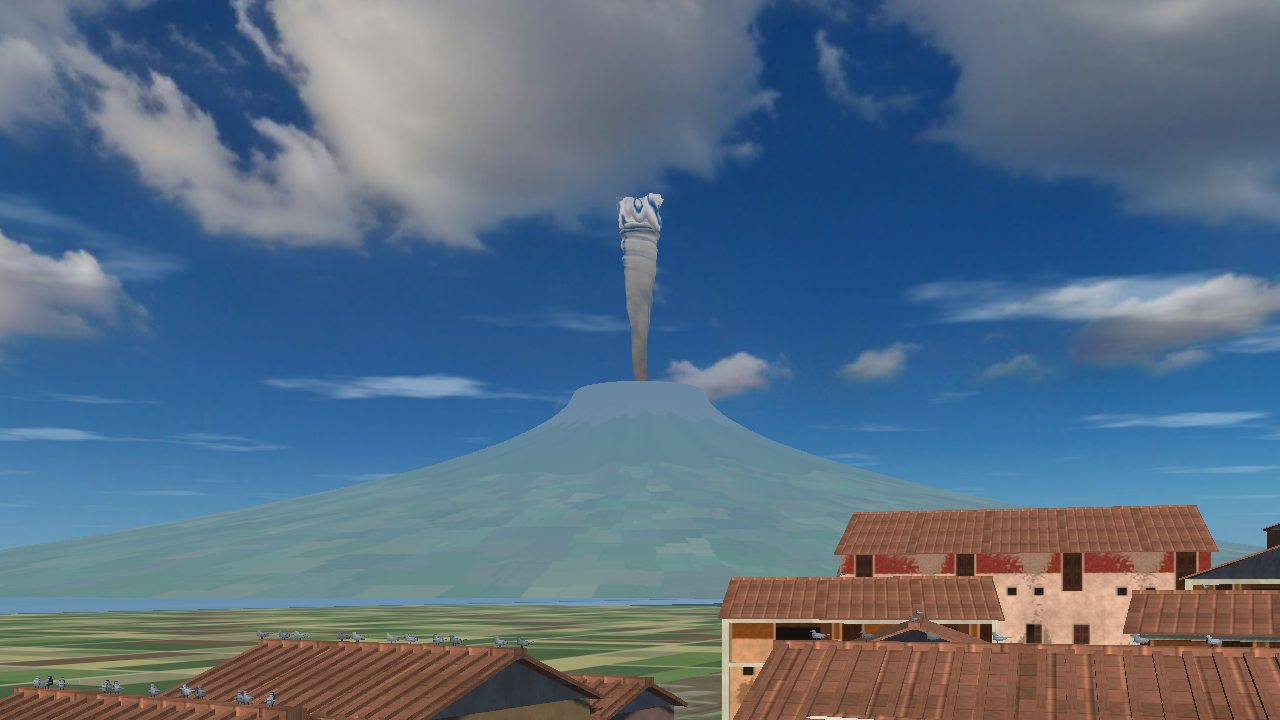
We remember best what we have felt
At A.G.I.R, we do not believe in commentary that explains the image from above. Here, nobody explains anything: a child asks the questions a visitor dares not ask, and his aunt answers them as one would answer one’s nephew.
This approach conveys, without ever lecturing, what a museum display struggles to make visitors remember. That Pompeii had running water. That the city had been a building site ever since the earthquake of 62. That Vesuvius was regarded as a harmless mountain covered in vineyards. These are facts, but they come across as conversations.
And because the city was initially portrayed as peaceful, the shift in tone needs no dramatic effects. It is encapsulated in a sentence from Valeria: ‘That mountain has never done anything. Never.’
The eruption, yes. The spectacle, no.
There was never a lava flow over Pompeii. Pumice stones fell from the sky, followed by ash, for hours on end. The popular image of lava rushing down the slopes is incorrect for this eruption: we have set it aside, and the experience corrects this common misconception without appearing to explain it, through a line spoken by Valeria - ‘It’s not fire that’s flowing. It’s the sky falling back down.’
Nor do we show any bodies, casts or scenes of agony. The experience ends with a prayer before the household altar. What followed is recounted in the epilogue, set in the present day.
Yet it does not gloss over anything. Until 29 August 2026, the ending was a departure for the harbour: everyone made it out alive. We have changed this to reflect the reality of the search - a significant proportion of the victims were found inside houses, not on the roads. Quintus voices the other outcome aloud, ‘the neighbours are heading down to the harbour’, and many did indeed escape that way. The audience therefore hears both versions, and it is Valeria’s choice that determines the outcome, not fate.
We witness the eruption.
We don’t turn it into a spectacle.
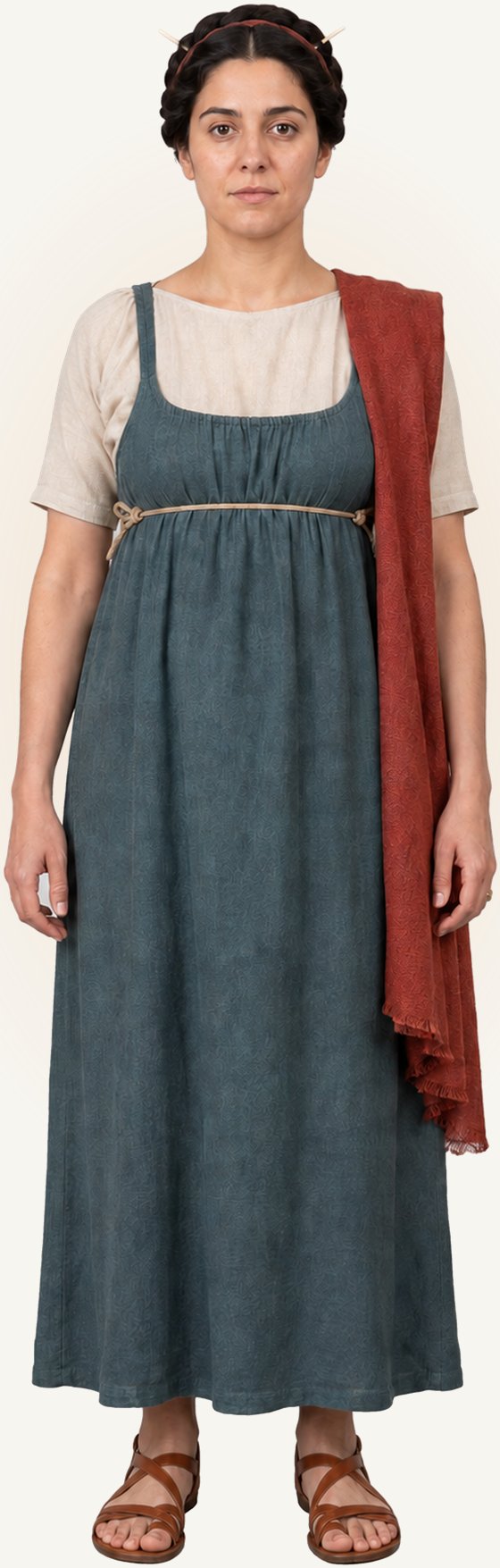
Valeria, and her nephew who has come from Rome
There are two of them in the house, and you are the third. Valeria plays host; Quintus is amazed by everything; you say nothing, and no one asks you anything. It is this very role that makes the day worth watching: you have nothing to decide, nothing to achieve, just to be there.
She conveys everything the story needs to convey without ever seeming to do so. The earth shook years ago; repairs are still underway. Her husband makes an offering at the lararium every morning; he did so that morning too. Venus watches over the city, and nothing ever happens to us.
Then, for the first time, she feels afraid, and she decides to stay. In the epilogue, she no longer acts out the scene: she speaks to the living, to you who have unearthed her house and who have her lamp before your eyes.
Nothing on the walls is invented;
everything has been recorded
No fresco has been invented. What is painted on our walls was recorded on site in the 19th century by draughtsmen who had the scenes before their eyes: Zahn, Mazois, Niccolini, Bazzani. The red of Pompeii is not a decorator’s idea; it is a record.
The same standard applies to the materials. If a modern roof tile were laid on a roof dating from the year 79, a curator would spot it. So the pattern, colour and layout of the walls, floors and roofs are drawn from these very same drawings, one by one.
And we are not reconstructing the entire city. Care is taken where the eye rests and where the hand might touch; beyond that come the roofs, then the sky. We conceal rather than build - a pillar, a trellis, a cypress tree, a canopy - and whatever is not mentioned in the text is not recreated.
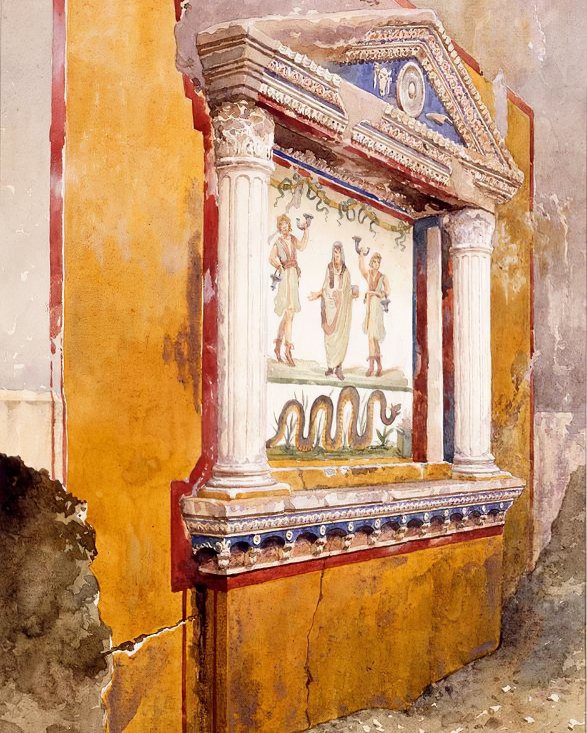
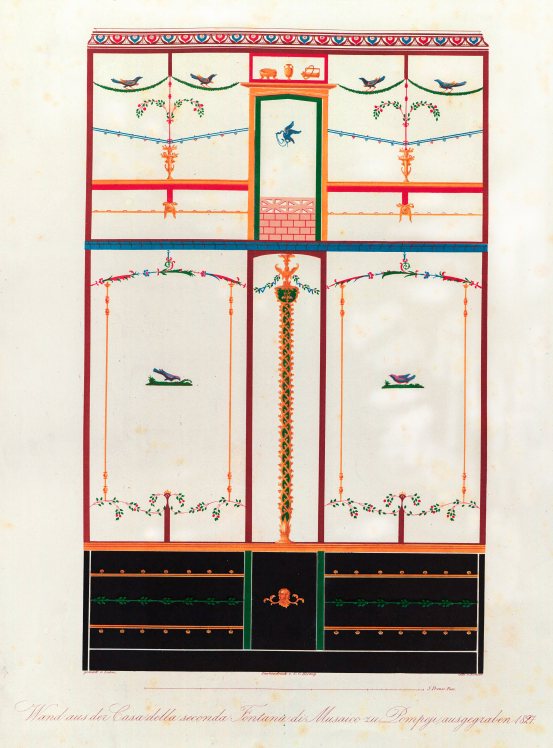
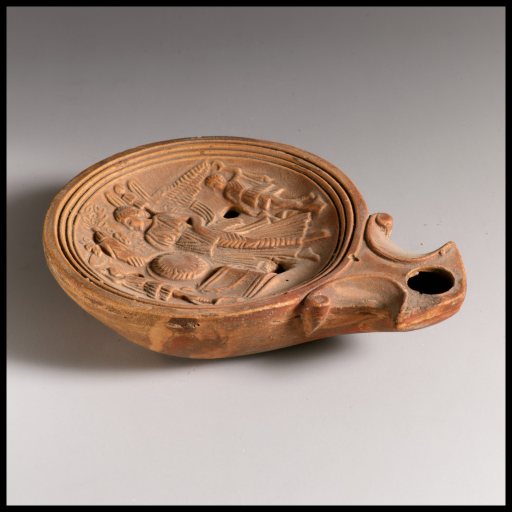
Pompeian red, the ochre of the walls, the terracotta of the roofs.
Pumice and ash: everything fades, nothing burns.
The plaster, the light-coloured dust, today’s light.
What the image conceals, the sound reveals
An aunt and her nephew, and a conversation that never includes you. That’s what makes it real: we’re not explaining anything to anyone; we’re simply answering a child who’s asking a question. You’re not the intended audience of the story; you’re in the room.
Fifty-seven lines of dialogue, but nearly six minutes without a single word. It’s not a shortcoming; it’s the structure: in virtual reality, you look first and listen afterwards. The quietest sequences are those where you turn to face the mountain.
Sound conveys what the image does not show: the fountain running dry, the birds flying off all at once, the sound of the pince on the tiles, the distant shouts in the street. You hear the rocking chair before you see it.
Are you interested in this experience?
Let’s discuss installing it in your home, the schedule and the access options.